How to Pick the Right Size Extension Cord for Generator
Choosing the right what size extension cord for generator depends on your wattage needs, cord length, and wire gauge. Using the wrong cord can cause voltage drops, overheating, or even fire hazards. This guide breaks down everything you need to pick the perfect generator extension cord for your setup.
You just fired up your portable generator during a blackout. You grab your extension cord, plug it in, and — nothing happens. Your fridge won’t start. The lights stay dark. What went wrong?
More often than not, the culprit is a cord that’s too thin, too long, or simply the wrong size extension cord for generator use. Picking the right cord isn’t just about convenience. It’s about safety, efficiency, and making sure your backup power actually works when you need it most.
This guide walks you through everything you need to know. From understanding wire gauges to calculating wattage needs, you’ll walk away confident in your choice. No guesswork. No safety risks. Just clear, practical advice that gets the job done right.
Key Takeaways
- Match the gauge to the wattage: Thicker cords like 10 AWG handle more power than thin 16 AWG cords.
- Shorter cords are better: Longer cords cause more voltage drop and power loss.
- Check your generator’s output: Your cord must handle the total wattage of all connected devices.
- Use outdoor-rated cords: Indoor cords lack the insulation needed for safe outdoor generator use.
- Never daisy-chain cords: Plugging one extension cord into another creates serious safety risks.
- Look for UL or ETL certification: These marks mean the cord meets safety standards.
- Match your plug type: Ensure the cord ends fit both your generator outlet and your appliances.
📑 Table of Contents
- Why Cord Size Matters for Generators
- How to Calculate Your Wattage Needs
- How Cord Length Affects Performance
- Best Extension Cords for Generator Use
- Common Mistakes People Make with Generator Cords
- Quick Tips for Safe Generator Cord Use
- How to Pick the Right Size Extension Cord for Generator: A Step-by-Step Guide
- Quick Reference: Size Chart for Generator Extension Cords
- Expert Insights on Generator Cord Sizing
- Final Thoughts
Why Cord Size Matters for Generators
Think of an extension cord like a water pipe. A thin pipe restricts water flow. A thick pipe lets water move freely. The same principle applies to electricity. A thin cord restricts electrical current, causing heat buildup and power loss.
Using the wrong generator extension cord can lead to real problems. Voltage drop means your appliances run poorly. Overheating means melted insulation and fire risk. And using an undersized cord can damage both your generator and your devices.
The two main factors that determine cord size are wire gauge and cord length. The gauge refers to the thickness of the wire inside. Lower numbers mean thicker wires. A 10 AWG cord carries more current than a 16 AWG cord. Length matters because electricity loses power as it travels. A 100-foot cord loses more energy than a 25-foot cord carrying the same load.
Understanding AWG (American Wire Gauge)
AWG is the standard measurement for wire thickness in the United States. It might seem confusing at first, but the system is actually straightforward. The lower the number, the thicker the wire. Here’s a quick breakdown of common gauges you’ll encounter:
- 10 AWG: Thick and heavy. Handles up to 30 amps. Best for large generators and high-wattage appliances.
- 12 AWG: A solid middle ground. Handles up to 20 amps. Great for medium-sized generators.
- 14 AWG: Lighter duty. Handles up to 15 amps. Works well for small generators and basic tools.
- 16 AWG: The thinnest common option. Handles up to 10 amps. Only suitable for very light loads.
When you’re figuring out what size extension cord for generator use, always start with your total wattage needs. Add up the wattage of every device you plan to run at the same time. Then choose a cord that can handle that load comfortably.
How to Calculate Your Wattage Needs
Before you buy any cord, you need to know how much power you’re drawing. This step is non-negotiable. Guessing leads to undersized cords, which leads to problems.
Start by listing every appliance or tool you want to power. Check the label on each device for its wattage rating. If the label shows only amps and volts, just multiply them together. Amps times volts equals watts. Simple as that.
Don’t forget about starting wattage. Many appliances — especially refrigerators and air conditioners — need a surge of power to kick on. That starting wattage can be two to three times the running wattage. Factor this into your total calculation.
Common Appliance Wattage Examples
To make this easier, here are some typical wattage values for common household items you might run off a generator:
- Refrigerator: 700 running watts, 2,200 starting watts
- Window AC unit (10,000 BTU): 1,200 running watts, 3,500 starting watts
- Sump pump: 1,300 running watts, 2,900 starting watts
- Microwave: 1,000 running watts
- Space heater: 1,500 running watts
- Television: 100 to 400 running watts
- Laptop: 50 to 100 running watts
- Phone charger: 5 to 20 running watts
Add these up for your total. Then pick a cord gauge that exceeds that total by at least 20%. This gives you a safety buffer and prevents the cord from running at its maximum capacity constantly.
How Cord Length Affects Performance
Here’s something many people overlook. The longer your cord, the more power it loses. This is called voltage drop, and it’s a real headache. A 50-foot 12-gauge cord works great for short runs. But stretch that to 150 feet and you’ll notice a significant drop in power delivery.
Voltage drop happens because electricity meets resistance as it flows through the wire. Longer cords mean more resistance. More resistance means less power reaching your appliances.
The Golden Rule of Cord Length
Keep your cord as short as possible. If you can run a 25-foot cord instead of a 100-foot cord, do it. Your appliances will perform better and your cord will stay cooler.
If you absolutely need a longer run, go up one gauge size to compensate. For example, if a 50-foot 12 AWG cord works for your load, use a 10 AWG cord for a 100-foot run. This ensures enough power reaches the end without dangerous voltage loss.
Another smart move is to place your generator as close to your house as safely possible. This shortens the cord length naturally and reduces power loss. Just make sure you follow all manufacturer guidelines for generator placement and electrical safety.
Best Extension Cords for Generator Use
Not all extension cords are created equal. Some are designed for indoor lamp use. Others are built to handle the demands of generator power. Knowing the difference saves you money and keeps you safe.
Indoor vs. Outdoor Rated Cords
Always use an outdoor-rated extension cord with your generator. Outdoor cords have thicker insulation that resists moisture, UV rays, and temperature changes. Indoor cords lack this protection and can degrade quickly when used outside.
Look for cords labeled “W” on the jacket. That letter means the cord is rated for outdoor use. It’s a simple but important detail that many people miss.
Heavy Duty vs. Light Duty
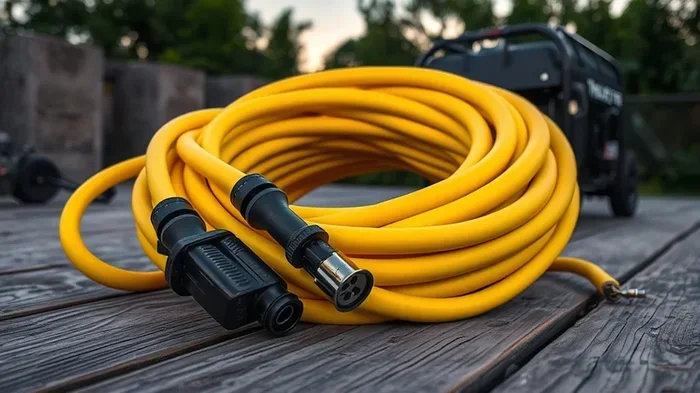
For generator use, you almost always want a heavy duty extension cord. These cords feature thicker wire gauges, better insulation, and grounded three-prong plugs. They’re built to handle sustained power loads without overheating.
Light duty cords are fine for phone chargers or desk lamps. But they simply can’t handle the demands of a generator powering your home’s essentials. Save yourself the risk and invest in the right cord from the start.
Top Features to Look For
When shopping for a generator extension cord, keep an eye out for these features:
- Weather-resistant jacket: Protects the cord from rain, sun, and debris.
- Grounded three-prong plugs: Provides a safety path for electrical surges.
- UL or ETL certification: Proves the cord meets independent safety standards.
- Litmus or color-coded outlets: Makes it easy to identify which outlets are live.
- Rubber or heavy vinyl construction: Offers superior durability compared to standard plastic-jacketed cords.
- Multiple outlets: Lets you power several devices from a single cord.
Common Mistakes People Make with Generator Cords
Even with the best intentions, plenty of folks make avoidable mistakes when setting up their generator cords. Learning from these errors keeps you safe and your equipment working.
Using Too Thin a Gauge
This is the number one mistake. People grab the first extension cord they find in the garage and hope for the best. A 16 AWG cord on a 3,000-watt generator is a recipe for disaster. The cord overheats, the insulation melts, and you’re left with a serious fire hazard.
Always match your cord gauge to your total wattage. When in doubt, go thicker. A heavier cord costs a bit more but provides peace of mind that’s absolutely worth it.
Daisy-Chaining Extension Cords
Plugging one extension cord into another is a dangerous practice. It creates excess resistance, increases heat buildup, and dramatically raises the risk of fire. The National Fire Protection Association explicitly warns against this.
If you need more length, buy a single cord that’s long enough. Don’t try to extend a cord by connecting two together. It’s never worth the risk.
Ignoring the Plug Connection Type
Generators use different outlet types depending on the model and wattage. Common types include L5-30, L14-30, and NEMA 5-20. If your cord doesn’t match your generator’s outlet, you’ll need an adapter or a different cord entirely.
Take a photo of your generator’s outlets before you shop. This simple step prevents buying the wrong cord and coming home disappointed.
Overloading the Cord
Every cord has a maximum amperage rating. Exceeding that rating — even briefly — can cause the cord to overheat. Check the rating on the cord’s jacket and never exceed it. If you’re running multiple high-wattage devices, make sure the combined load stays well below the cord’s maximum capacity.
Quick Tips for Safe Generator Cord Use
Safety should always come first when working with generators and extension cords. Here are some quick tips that make a big difference:
- Inspect your cord before every use. Look for cuts, fraying, or exposed wires. A damaged cord is a dangerous cord.
- Keep cords dry. Water and electricity are a deadly combination. Use cord covers or elevate cords off wet ground.
- Don’t run cords under rugs or through windows. Both scenarios can damage the cord insulation and create fire risks.
- Use a surge protector for sensitive electronics. Generators can produce dirty power that damages delicate devices.
- Store cords properly. Coil them loosely and hang them in a dry place. Tight coils create heat buildup during storage.
- Match the cord’s amperage rating to your generator’s output. A 30-amp generator needs a cord rated for at least 30 amps.
- Warm cords are normal. Hot cords are not. If your cord is too hot to touch, unplug immediately and reduce the load.
These small habits add up to a much safer and more reliable generator setup. Take the extra few minutes to check your equipment each time. Your safety — and your wallet — will thank you.
How to Pick the Right Size Extension Cord for Generator: A Step-by-Step Guide
Now that you understand the basics, let’s put it all together. Here’s a simple step-by-step process to find the perfect cord for your generator.
- List all devices you want to power. Write down each one and its wattage rating.
- Add up the total running watts. Include starting watts for any motor-driven appliances.
- Choose the right gauge. Use the total wattage to determine your minimum wire gauge. Higher wattage needs thicker wire.
- Measure your distance. Figure out how far the cord needs to reach from the generator to your home or appliances.
- Select a cord length. Pick the shortest cord that reaches your destination. If you need more length, increase the gauge size.
- Verify the plug type. Make sure the cord ends match both your generator outlet and your appliance plugs.
- Check for certifications. Look for UL, ETL, or CSA marks on the cord.
- Buy and test. Run your setup and monitor the cord for heat. It should stay warm, never hot.
Follow these steps and you’ll have a safe, efficient setup every time. The key is planning ahead rather than grabbing whatever cord is handy.
Quick Reference: Size Chart for Generator Extension Cords
Use this chart as a general guide when choosing your cord. Remember that these are starting points. Always check your specific generator and appliance requirements for the most accurate sizing.
- Up to 1,500 watts: 16 AWG cord, up to 50 feet
- 1,500 to 3,000 watts: 14 AWG cord, up to 50 feet
- 3,000 to 5,000 watts: 12 AWG cord, up to 100 feet
- 5,000 to 7,500 watts: 10 AWG cord, up to 100 feet
- 7,500 to 10,000 watts: 10 AWG cord, up to 150 feet
- 10,000+ watts: 8 AWG cord, up to 150 feet
This chart assumes standard outdoor-rated cords with proper grounding. If you’re running a longer distance, go up one gauge size from what’s listed here. It’s always better to have more capacity than you need.
Expert Insights on Generator Cord Sizing
Electrical professionals consistently emphasize one thing: when it comes to power cord sizing, bigger is almost always better. A cord that handles more than your actual load runs cooler, lasts longer, and delivers more consistent power to your devices.
Many electricians recommend adding a 20% buffer to your total calculated wattage. So if your devices add up to 4,000 watts, choose a cord rated for at least 4,800 watts. That buffer protects against surges and ensures your cord isn’t working at its absolute maximum.
Another pro tip is to invest in a generator inlet box if you plan to use your generator frequently. An inlet box installs on the exterior of your home and provides a safe, weatherproof connection point. You plug the generator into the inlet box and run the cord through a dedicated opening. It’s cleaner, safer, and more convenient than running cords through windows or doors.
Some homeowners also ask about using a surge protector between the generator and their electronics. This is a smart move, especially for sensitive equipment like computers and televisions. Generator power can be inconsistent, and a surge protector adds an extra layer of defense against voltage spikes.
Final Thoughts
Picking the right size extension cord for generator use doesn’t have to be complicated. Start with your wattage needs, choose the correct gauge, keep the cord as short as possible, and always use outdoor-rated cords. Follow the safety tips outlined in this guide, and you’ll have a reliable, efficient setup every time.
The right cord makes all the difference. It keeps your appliances running smoothly during a blackout. It protects your family from electrical hazards. And it gives you the confidence that your backup power system will work when you need it most. Take the time to get it right — your safety and comfort depend on it.
Now that you know the ins and outs of generator extension cord sizing, you’re ready to make a smart, informed choice. Grab your list of appliances, check those wattage numbers, and pick the perfect cord for your setup. You’ve got this.
Frequently Asked Questions
What size extension cord for a 7500 watt generator?
For a 7500 watt generator, use a 10 AWG heavy duty extension cord rated for at least 30 amps. If your run exceeds 100 feet, consider stepping up to an 8 AWG cord to minimize voltage drop. Always check your generator’s outlet type and match it to the cord’s plug.
Can I use a 14 gauge extension cord with a generator?
Yes, but only for light loads up to about 1,500 watts. A 14 AWG cord works well for small appliances like lamps, phone chargers, and televisions. Avoid using 14 AWG cords for high-wattage devices like space heaters, air conditioners, or power tools.
What happens if I use the wrong size extension cord with my generator?
Using an undersized cord causes voltage drop, overheating, and potential fire hazards. Your appliances may run poorly or not at all. In worst-case scenarios, an overloaded cord can melt its insulation and start a fire. Always match your cord to your total wattage needs.
How long can a generator extension cord be?
There’s no strict maximum length, but longer cords lose more power through voltage drop. For best results, keep your cord under 100 feet. If you need a longer run, increase the wire gauge to compensate. A 10 AWG cord handles longer runs better than a 14 AWG cord.
Do I need a special extension cord for a generator?
Yes. You should always use an outdoor-rated, heavy duty extension cord with a generator. Look for cords with a “W” rating on the jacket, grounded three-prong plugs, and UL or ETL certification. Standard indoor cords lack the insulation and durability needed for safe generator use.
Can I plug multiple extension cords into my generator?
You can plug multiple cords into your generator if it has multiple outlets, but never daisy-chain cords by plugging one extension cord into another. Each cord should run directly from the generator to the device it powers. Daisy-chaining creates excess heat and serious fire risks.
=== CONCLUSION ===
Choosing the right what size extension cord for generator use comes down to three things: wattage, gauge, and length. Know your power needs, pick the correct wire thickness, and keep your cord run as short as possible. Follow the safety tips and quick reference chart in this guide, and you’ll set up a safe, efficient generator system every single time.
Don’t leave this to chance. Take a few minutes today to check your current cord and make sure it’s up to the task. A small investment in the right generator extension cord pays off big in safety, performance, and peace of mind.