How much air compressor do i need for home projects
Choosing the right air compressor starts with knowing your project needs, tool requirements, and workspace limits. This guide breaks down CFM, PSI, tank sizes, and compressor types so you can pick the perfect air compressor for your home projects without overspending or underperforming.
Key Takeaways
- CFM and PSI are the two numbers that matter most: Match them to your tools for the best performance.
- Tank size affects runtime, not power: Larger tanks give you more continuous air but don’t increase pressure.
- Light-duty tasks need 1-2 HP compressors: Tire inflation, brad nailers, and small sanders work great with compact models.
- Heavy-duty home projects demand 3-5 HP units: Framing nailers, sandblasters, and paint sprayers need serious airflow.
- Electric compressors suit indoor garages: They’re quieter, cleaner, and easier to maintain than gas models.
- Don’t skip the duty cycle: It tells you how long the compressor can run before overheating.
- Buy one size up from your current needs: Future-proof your setup so you’re ready for bigger projects.
📑 Table of Contents
- How Much Air Compressor Do I Need for Home Projects?
- Understanding Air Compressor Basics
- How Much Air Compressor Do I Need for Common Home Projects?
- Types of Air Compressors for Home Use
- Matching Your Compressor to Your Tools
- Electric vs Gas Compressors for Home Use
- Common Mistakes When Choosing a Home Air Compressor
- Quick Tips for Getting the Most Out of Your Compressor
- Final Thoughts
How Much Air Compressor Do I Need for Home Projects?
You’ve got a garage full of tools and a long list of weekend projects. But here’s the thing — picking the right air compressor can feel confusing. There are so many sizes, types, and numbers thrown around. CFM. PSI. Horsepower. Tank size. It’s enough to make anyone’s head spin.
The truth is simpler than it looks. Once you understand what your tools need and what your projects demand, the decision gets a lot easier. This guide walks you through everything you need to know about how much air compressor do I need for home use. Whether you’re inflating tires or running a paint sprayer, we’ve got you covered.
By the end, you’ll know exactly what size compressor fits your shop, your budget, and your DIY goals. No guesswork. No wasted money. Just clear, practical advice you can use right away.
Understanding Air Compressor Basics
Before you shop, let’s talk basics. Air compressors have a few key specs that determine what they can do. Don’t worry — you don’t need an engineering degree to understand them.
What Does CFM Mean?
CFM stands for Cubic Feet per Minute. It measures how much air the compressor delivers. Think of it like water flow from a hose. More CFM means more air reaches your tools at once.
Every air tool has a CFM requirement listed on its label or manual. Your compressor needs to meet or exceed that number. If it falls short, your tools won’t work properly. They’ll stall, lose power, or won’t start at all.
What Does PSI Mean?
PSI stands for Pounds per Square Inch. It measures air pressure. Higher PSI means more force behind the air. Some tools need high pressure to function. Others just need a steady stream of air at low pressure.
Most home compressors operate between 90 and 150 PSI. That covers the vast majority of DIY home projects. Check your tool’s PSI requirement and make sure your compressor can deliver it consistently.
Tank Size vs. Motor Power
Here’s a common mix-up. People think a bigger tank means more power. It doesn’t. The tank size determines how much compressed air is stored. The motor (measured in horsepower) determines how fast the compressor fills that tank.
A larger tank gives you longer runtime between refill cycles. That’s great for tools that need continuous air, like sanders or sprayers. But the motor is what actually does the work. So balance both when choosing your air compressor for home use.
Duty Cycle Explained
Duty cycle tells you how long a compressor can run before it needs to rest. It’s shown as a percentage. A 50% duty cycle means the compressor runs for 5 minutes out of every 10. The rest is cooldown time.
For home projects, look for at least a 50% duty cycle. If you plan on running tools for long stretches, go higher. A compressor that overheats mid-project is frustrating and can damage the motor.
How Much Air Compressor Do I Need for Common Home Projects?
Your project type determines the compressor size you need. Let’s break it down by project category so you can find your match.
Light-Duty Tasks
Light-duty tasks are perfect for small, portable compressors. These include:
- Tire inflation
- Running a brad nailer
- Small sanding jobs
- Blowing out dust from surfaces
- Inflating sports equipment or pool toys
For these jobs, a 1 to 1.5 HP compressor with 2 to 4 CFM at 90 PSI works great. A compact pancake compressor or a small hot dog model handles light tasks with ease. These units are lightweight, affordable, and easy to store in a closet or garage corner.
If you’re also using a portable generator to power your compressor outdoors, make sure your generator can handle the startup wattage. Check out how many watt generator do I need for a detailed guide on matching power sources to your tools.
Medium-Duty Projects
Medium-duty projects step up the intensity. You’ll need more airflow and a slightly bigger motor. Common medium-duty tasks include:
- Framing nailers for deck building
- Finish carpentry work
- Air-brushing and detail painting
- Running impact wrenches for automotive work
- Sandblasting small surfaces
For medium projects, aim for a 2 to 3 HP compressor with 4 to 6 CFM at 90 PSI. A wheeled twin-stack compressor gives you the storage capacity and airflow you need without taking over your entire garage.
These models are the sweet spot for most homeowners. They handle a wide range of tasks and still fit in a reasonable workspace. If you’re setting up a permanent workshop, this is the category worth investing in.
Heavy-Duty Home Projects
Heavy-duty projects demand serious airflow and pressure. If you’re doing any of the following, you need a beefy compressor:
- Running multiple nail guns at once
- Continuous sandblasting
- Large-scale painting with HVLP sprayers
- Operating impact wrenches for heavy automotive repair
- Running pneumatic presses or CNC machines
You’ll want a 5 HP or larger compressor with 10+ CFM at 100+ PSI. These units often come with large tanks (60+ gallons) and wheels for mobility. They’re an investment, but they handle the toughest home workshop jobs without breaking a sweat.
Heavy-duty compressors also tend to be louder. Plan your workspace accordingly. If noise is a concern, consider sound-dampening enclosures or placing the compressor in a separate area with hoses running to your work zone.
Types of Air Compressors for Home Use
Not all compressors are created equal. The type you choose depends on your space, budget, and project needs. Let’s look at the main options.
Pancake Compressors
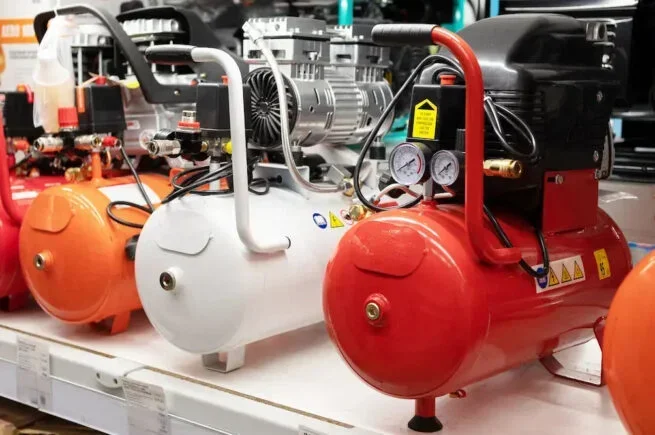
Pancake compressors are the most popular choice for home garages. They’re flat, compact, and easy to store. The tank sits below the motor, giving them a low profile that slides under a workbench or into a corner.
Most pancake models deliver 1 to 2 HP with 2 to 4 CFM. They’re perfect for light to medium tasks. The trade-off? Smaller tanks mean more frequent refill cycles during continuous use. But for occasional DIY home projects, they’re hard to beat.
Hot Dog and Twin-Stack Compressors
Hot dog compressors have a vertical tank that looks like a hot dog lying on its side. They’re slightly more portable than pancake models and offer a bit more capacity.
Twin-stack compressors stack two tanks vertically for more air storage without adding much footprint. They’re a great middle ground between compact portability and serious runtime. For homeowners who want flexibility, a twin-stack model is a smart pick.
Wheeled and Stationary Compressors
Wheeled compressors are built for heavy use. They come with large tanks, powerful motors, and sturdy wheels for easy movement. These are the workhorses of the home shop.
Stationary compressors stay in one place and connect to your tool setup via hoses and regulators. They deliver the highest CFM and PSI ratings. If you have a dedicated workshop with multiple air tools, a wheeled or stationary unit is the way to go.
Oil-Free vs Oil-Lubricated
Oil-free compressors require less maintenance and are lighter. They’re great for home garages where you don’t want to deal with oil changes. The trade-off is they tend to be louder and may not last as long under heavy use.
Oil-lubricated compressors run smoother and cooler. They last longer under continuous use and are quieter. But they need regular oil maintenance. For most homeowners, oil-free models strike the right balance between convenience and performance.
Matching Your Compressor to Your Tools
This is the most important step. Your compressor needs to keep up with your tools. Here’s how to match them up.
Nail Guns and Fastening Tools
Brad nailers and finish nailers need 0.3 to 0.5 CFM at 70 to 90 PSI. A small pancake compressor handles these easily. Framing nailers are hungrier — they need 2 to 3 CFM at 90 PSI. For framing work, go with a 2.5 to 3 HP compressor.
If you’re running a nail gun alongside other tools, add up the CFM requirements. Your compressor needs to supply all of them at once. This is where people underestimate their needs and end up with a compressor that can’t keep up.
Paint Sprayers
Paint sprayers love steady airflow. HVLP sprayers typically need 3 to 6 CFM at 40 PSI. Large sprayers for full-body automotive work can need 10+ CFM. If painting is a big part of your projects, invest in a compressor with a large tank and high CFM output.
A larger tank also helps maintain consistent pressure while you spray. Fluctuating pressure shows up as uneven paint coverage. Nobody wants that. A steady supply of air gives you smooth, professional-looking results every time.
Impact Wrenches and Heavy Tools
Impact wrenches are power hogs. A 1/2-inch impact wrench needs about 4 to 5 CFM at 90 PSI. A 3/4-inch model can need 7 to 10 CFM. That’s serious airflow.
If you plan on using impact wrenches regularly for automotive or construction work, you need a compressor in the 3 to 5 HP range with a large tank. Trying to run a heavy impact wrench on an undersized compressor will just lead to frustration and poor performance.
Electric vs Gas Compressors for Home Use
Choosing between electric and gas comes down to where and how you’ll use your compressor.
Electric Compressors
Electric compressors are the go-to for most home garages. They’re quieter, cleaner, and easier to start. You just plug them in and go. No fuel, no fumes, no pull cords.
They work great indoors and in enclosed spaces. Maintenance is minimal — just keep the air filter clean and drain the tank moisture regularly. For the average homeowner, an electric compressor covers 90% of home project needs.
Gas Compressors
Gas compressors shine in outdoor settings. They deliver more power and run longer without needing an electrical outlet. If you work on job sites or in areas without reliable electricity, a gas model makes sense.
The downsides are noise, fumes, and regular maintenance. You need to mix fuel, change oil, and store gasoline safely. For most home garages, gas compressors are overkill. But for outdoor construction or remote work sites, they’re unbeatable.
If you’re considering a backup power setup for your garage, you might also want to explore how much a home generator costs. Sometimes a generator lets you run both your compressor and other tools during power outages.
Common Mistakes When Choosing a Home Air Compressor
Avoid these pitfalls so you don’t end up with the wrong compressor for your needs.
Mistake 1: Buying based on price alone. The cheapest compressor might not have the CFM or PSI your tools need. Always check tool requirements first, then find a compressor that meets them.
Mistake 2: Ignoring duty cycle. A compressor with a low duty cycle will overheat if you run it continuously. Check the duty cycle rating and match it to your project length.
Mistake 3: Underestimating CFM needs. Add up the CFM of all the tools you’ll run simultaneously. Then add 25% extra buffer. This gives you room to breathe and prevents the compressor from maxing out.
Mistake 4: Forgetting about portability. If you move your compressor between rooms or job sites, weight and wheel size matter. A 60-gallon compressor on a tiny dolly is still hard to move. Consider your storage space and mobility needs before you buy.
Mistake 5: Skipping the regulator. A pressure regulator lets you adjust output for different tools. Without one, you risk damaging sensitive equipment or getting inconsistent performance. Most quality compressors include one, but always double-check.
Quick Tips for Getting the Most Out of Your Compressor
- Drain your tank after every use. Moisture builds up and causes rust. A quick drain after each session extends your compressor’s life significantly.
- Check hoses for leaks regularly. Even a small leak wastes air and forces your compressor to work harder.
- Keep the intake filter clean. A clogged filter reduces airflow and makes the motor work harder. Clean it monthly during heavy use.
- Store your compressor in a dry place. Moisture and humidity damage internal components over time.
- Use the right oil. If your compressor needs oil, use the manufacturer’s recommended grade. Wrong oil leads to premature wear.
- Let it cool between heavy sessions. Even with a good duty cycle, giving your compressor rest periods extends motor life.
Final Thoughts
So, how much air compressor do I need for home projects? The answer depends entirely on what you plan to build, what tools you’ll use, and how much space you have. For most homeowners, a 2 to 3 HP compressor with 4 to 6 CFM covers the full range of common tasks. It handles nail guns, paint sprayers, impact wrenches, and sanders without breaking a sweat.
Start by listing your tools and their CFM and PSI requirements. Add up the numbers. Then choose a compressor that meets or exceeds those totals with a little extra headroom. That’s the sweet spot — enough power for today’s projects and room to grow for tomorrow’s ambitions.
Don’t overthink it. The right air compressor for home use doesn’t have to be complicated. Pick a reliable brand, match the specs to your needs, and you’ll be ready to tackle any project that comes your way. Happy building!
Frequently Asked Questions
What size air compressor do I need for a home garage?
For most home garages, a 2 to 3 HP compressor with 4 to 6 CFM at 90 PSI is the sweet spot. It handles common tools like nail guns, sanders, and small impact wrenches. If you plan on running multiple tools at once, add up their CFM requirements and choose a compressor that exceeds the total.
Can I run an air compressor indoors?
Yes, electric compressors are safe and practical for indoor use. They produce no fumes and run quietly compared to gas models. Just make sure your garage or workshop has adequate ventilation and that the compressor sits on a stable, level surface. Oil-free models are especially well-suited for indoor home workshops.
How do I know if my compressor is too small?
If your tools stall, lose pressure, or won’t start, your compressor is likely undersized. Check the CFM and PSI ratings on each tool and compare them to your compressor’s output. If your compressor can’t keep up with the combined demand, it’s time to upgrade to a larger unit.
Do I need a compressor with a large tank?
A larger tank doesn’t mean more power. It means more stored air and longer runtime between refill cycles. If you use tools that need continuous airflow — like sanders or paint sprayers — a bigger tank helps. For intermittent tasks like tire inflation or quick nail gun work, a smaller tank is perfectly fine.
Is a 1.5 HP compressor enough for home projects?
A 1.5 HP compressor works great for light to medium tasks. It handles brad nailers, tire inflators, small sanders, and light finishing work. However, if you plan on using framing nailers, impact wrenches, or paint sprayers regularly, you’ll want to step up to a 2.5 or 3 HP model for reliable performance.
What’s the difference between CFM and SCFM?
CFM (Cubic Feet per Minute) measures airflow at actual operating conditions. SCFM (Standard Cubic Feet per Minute) measures airflow at standardized conditions — typically 14.5 PSI, 68°F, and 36% humidity. SCFM numbers are usually higher because they represent ideal conditions. Always compare CFM ratings at the same pressure when choosing a compressor.