
How Many Watt Generator to Run a House For Your Home
Choosing the right generator starts with knowing how many watt generator to run a house requires. Most homes need between 5,000 and 7,500 watts for essentials, while full-house backup may call for 10,000 to 15,000 watts or more. This guide breaks down wattage calculations, appliance needs, and generator types so you can make a confident, informed choice for your home’s backup power.
Power outages happen when you least expect them. A storm rolls in, a tree falls on a line, or the grid simply fails. When the lights go out, the first question most homeowners ask is simple: how many watt generator to run a house?
The answer isn’t one-size-fits-all. Your power needs depend on what you want to run, how many appliances you use, and whether you’re covering just the essentials or your entire home. This guide walks you through everything you need to know about generator wattage, home power needs, and choosing the right generator size for your situation.
By the end, you will have a clear picture of what wattage requirements look like for a typical home. You will also know exactly what to look for when shopping for a backup power solution. Let us break it all down.
Key Takeaways
- Know your wattage needs: Calculate both starting and running watts to avoid overloading your generator.
- Essential vs. full-house power: A 5,000–7,500 watt unit covers basics, while 10,000+ watts handles the entire home.
- Choose the right type: Portable generators work for essentials, while standby generators offer full automatic backup.
- Check your electrical panel: Your main breaker size affects how much power your generator can safely deliver.
- Avoid common mistakes: Don’t ignore surge wattage or underestimate your actual power consumption.
- Fuel matters: Propane, natural gas, and gasoline each have different run times and costs to consider.
📑 Table of Contents
- Understanding Wattage: Starting vs Running Power
- How to Calculate Your Home’s Power Needs
- Types of Generators for Running a House
- Essential Appliances and Their Wattage Requirements
- How to Choose the Right Generator Size
- Common Mistakes When Sizing a Generator
- Expert Tips for Getting the Most Out of Your Generator
- How Many Watt Generator to Run a House: Quick Reference Guide
- Conclusion
Understanding Wattage: Starting vs Running Power
Before you can figure out how many watt generator to run a house, you need to understand two key concepts: starting watts and running watts. These two numbers are very different, and confusing them is the number one mistake homeowners make.
What Are Running Watts?
Running watts are the continuous power a generator supplies to keep appliances running smoothly. Think of it like cruising on a highway. Your car uses a steady amount of fuel at a constant speed. Running watts work the same way. A refrigerator, for example, might need 700 watts to keep running once it is up and going.
What Are Starting Watts?
Starting watts (also called surge watts) are the extra burst of power needed to kick an appliance on. When a motor starts, it needs a big jolt of energy for a few seconds. A refrigerator compressor, for instance, might need 2,200 watts to start up even though it only runs on 700 watts.
This difference matters a lot. If your generator cannot handle the surge wattage, your appliances will not start. You might even trip the generator’s breaker or damage your equipment.
Why This Distinction Matters
Every generator has two ratings: a running watt rating and a starting watt rating. The starting watt rating is always higher. When you add up your home’s power consumption, you must account for both numbers. Add up all the running watts first. Then check if any appliance has a high starting watt demand. Make sure your generator can handle that surge.
How to Calculate Your Home’s Power Needs
Figuring out your wattage requirements is easier than it sounds. You just need to know what appliances you plan to run and how much power each one uses. Here is a simple step-by-step approach.
Step 1: List Your Essential Appliances
Start by writing down everything you need during a power outage. Most homeowners prioritize these items:
- Refrigerator and freezer
- Lights (a few rooms)
- Sump pump
- Window air conditioner or heater
- Television
- Phone and laptop chargers
- Microwave
- Well pump (if applicable)
Step 2: Find Each Appliance’s Wattage
Check the label on each appliance or look up its specs online. You will usually find two numbers: the running wattage and the starting wattage. Write both down next to each appliance.
Step 3: Add It All Up
Now add up all the running watts. Then check which appliance has the highest starting watt requirement. Add that starting watt number to your running total. The result is the minimum generator wattage you need.
Here is a quick example:
- Refrigerator: 700 running / 2,200 starting
- Freezer: 500 running / 1,500 starting
- Lights (4 rooms): 400 running / 0 starting
- Microwave: 1,000 running / 1,500 starting
- Television: 200 running / 0 starting
- Phone chargers: 100 running / 0 starting
Running total: 2,900 watts. Highest starting surge: 2,200 watts (refrigerator). Total needed: 2,900 + 2,200 = 5,100 watts. A 5,500 watt generator would handle this setup comfortably.
Step 4: Add a Safety Buffer
Always add about 20 percent extra capacity to your total. This buffer protects your generator from running at full blast all the time, which shortens its lifespan. It also gives you room if you decide to plug in something extra later.
Types of Generators for Running a House
Not all generators are the same. The type you choose affects how much power you get, how it runs, and what it costs. Here are the main options for homeowners asking how many watt generator to run a house.
Portable Generators
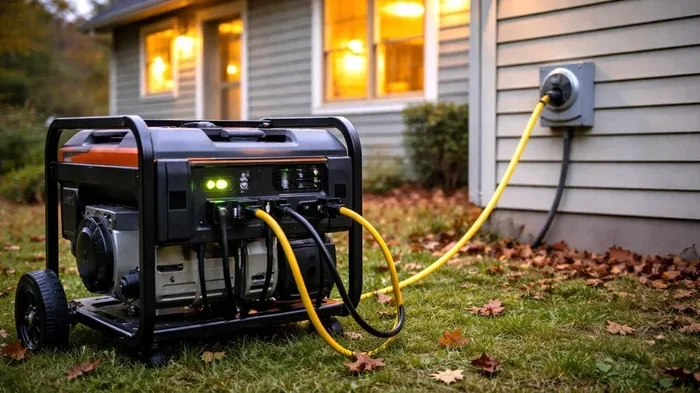
Portable generators are the most affordable option. They typically range from 3,000 to 8,500 watts. You can move them around, store them easily, and they run on gasoline or propane.
These work great for covering essentials during an outage. You plug appliances directly into the generator using extension cords. The downside is that you need to run them outside, they can be noisy, and they require manual refueling.
Portable Power Stations
Portable power stations are battery-powered units that store energy ahead of time. They are silent, emission-free, and easy to use indoors. However, their wattage capacity is usually lower than gas generators, and they take time to recharge.
These are best for short outages or for running a few essential devices like phones, laptops, lights, and a small refrigerator.
Standby Generators
Standby generators are the heavy-duty option. They are permanently installed outside your home and connect directly to your electrical panel or natural gas line. When the power goes out, they kick on automatically within seconds.
These units typically range from 7,000 to 24,000 watts or more. They can power your entire house, including central air, electric water heaters, and multiple kitchen appliances. The tradeoff is higher cost, professional installation, and regular maintenance.
Inverter Generators
Inverter generators produce clean, stable power that is safe for sensitive electronics like laptops and TVs. They are more fuel-efficient and quieter than traditional portable generators. However, they usually max out around 4,000 to 7,000 watts, so they are best for essential circuits only.
| Generator Type | Typical Watt Range | Best For | Auto Start? |
|---|---|---|---|
| Portable Generator | 3,000 – 8,500 W | Essentials, temporary use | No |
| Inverter Generator | 2,000 – 7,000 W | Sensitive electronics, camping | No |
| Portable Power Station | 500 – 3,000 W | Short outages, devices | Yes |
| Standby Generator | 7,000 – 24,000+ W | Whole house, automatic backup | Yes |
Essential Appliances and Their Wattage Requirements
To get a real sense of how many watt generator to run a house, you need to understand what your appliances actually draw. Here is a breakdown of common household items and their typical wattage.
Kitchen Appliances
- Refrigerator: 700 running watts, 2,200 starting watts
- Freezer: 500 running watts, 1,500 starting watts
- Microwave: 1,000 running watts, 1,500 starting watts
- Coffee maker: 800 running watts, 0 starting watts
- Toaster: 800 running watts, 0 starting watts
- Dishwasher: 1,200 running watts, 1,800 starting watts
Heating and Cooling
- Window AC unit (10,000 BTU): 1,200 running watts, 3,000 starting watts
- Central AC (3-ton): 3,500 running watts, 10,500 starting watts
- Space heater: 1,500 running watts, 0 starting watts
- Electric furnace: 5,000 running watts, 0 starting watts
Household Electronics
- Television (50-inch LED): 120 running watts, 0 starting watts
- Laptop: 50-100 running watts, 0 starting watts
- Phone charger: 10-20 running watts, 0 starting watts
- Wi-Fi router: 10 running watts, 0 starting watts
- Desktop computer: 300-500 running watts, 0 starting watts
Water and Laundry
- Well pump: 1,000 running watts, 3,500 starting watts
- Washing machine: 500 running watts, 1,500 starting watts
- Dryer (electric): 5,000 running watts, 0 starting watts
- Electric water heater: 4,000 running watts, 0 starting watts
As you can see, some appliances draw a lot more power than others. Heating and cooling devices are the biggest power hogs in any home. If you plan to run central air during an outage, you will need a much larger generator than someone who just wants to keep the lights on and charge their phone.
How to Choose the Right Generator Size
Now that you understand wattage and have a list of your appliances, it is time to pick the right generator size. The goal is to find a unit that meets your wattage requirements without being oversized or undersized.
Sizing for Essentials Only
If you only need to run the basics, look for a generator in the 3,000 to 5,500 watt range. This covers a refrigerator, a few lights, phone charging, and a sump pump. A 5,000 watt generator is one of the most popular choices for this use case. It is affordable, portable, and handles most essential circuits with room to spare.
Sizing for Partial House Coverage
Want to run more than just the essentials? A 7,000 to 10,000 watt generator gives you the flexibility to add a window AC unit, a microwave, and a few more lights. This range works well for many families during extended outages. It keeps your home comfortable and functional without the cost of a full standby system.
Sizing for Whole House Coverage
How many watt generator to run a house completely depends on your home’s size, the appliances you have, and your local climate. For most homes, a 10,000 to 15,000 watt standby generator covers the essentials plus heating or cooling and several other circuits.
Larger homes with electric water heaters, central air, electric stoves, and multiple bathrooms may need a 20,000 to 24,000 watt generator or more. The best approach is to add up every major appliance and circuit you want to keep running during an outage.
Matching Generator Size to Your Electrical Panel
Your home’s electrical panel also plays a role. Most residential panels are rated for 100, 150, or 200 amps. A 200-amp panel can handle more power than a 100-amp panel. If you install a standby generator, an electrician will help you match the generator’s output to your panel’s capacity using a transfer switch.
Quick Tips for Sizing Your Generator
- Always check starting watts, not just running watts.
- Add a 20 percent safety buffer to your total.
- Consider future needs. You might add a new appliance later.
- If you are unsure, consult a licensed electrician.
- Do not try to run everything at once. Prioritize essential circuits.
Common Mistakes When Sizing a Generator
Many homeowners make avoidable errors when they try to figure out how many watt generator to run a house. Here are the most common mistakes and how to dodge them.
Ignoring Starting Watts
This is the biggest mistake. If you only add up running watts, your generator will fail to start motor-driven appliances like refrigerators, well pumps, and AC units. Always account for the surge wattage.
Underestimating Power Consumption
It is easy to forget about the little things. A sump pump, a sump pump float switch, or a sump pump alarm might not seem like much, but they add up. Write down every single device you want to run and add their wattage together.
Buying the Cheapest Option
A low-cost generator might seem like a great deal until it fails to start your AC or trips its breaker constantly. Spending a little more on the right generator size saves you frustration and protects your appliances.
Overloading the Generator
Running your generator at or near its maximum capacity for hours on end is hard on the engine and your appliances. Keep your load at 80 percent or less of the generator’s rated capacity for best results and longer equipment life.
Forgetting About Fuel and Run Time
A bigger generator does not always mean better. Consider how much fuel it uses and how long it runs on a tank. A propane generator or natural gas generator can run longer than a gasoline model, which matters during extended outages.
Skipping Professional Installation
If you buy a standby generator, do not try to install it yourself. A licensed electrician ensures the transfer switch is wired correctly, the unit is properly grounded, and everything meets local building codes.
Expert Tips for Getting the Most Out of Your Generator
Once you have the right generator size, a few simple habits will keep it running strong and safe.
Test It Regularly
Run your generator at least once a month for 15 to 20 minutes. This keeps the engine in good shape and lets you spot any problems before you actually need it during a real outage.
Store Fuel Safely
If you have a gasoline generator, keep fuel in approved containers in a cool, ventilated area. Gasoline degrades over time, so use a fuel stabilizer if you store it for more than 30 days.
Use a Transfer Switch
A transfer switch lets you connect your generator directly to your home’s wiring safely. It prevents backfeed, which can be deadly to utility workers. Never plug a generator directly into a wall outlet.
Keep It Dry and Ventilated
Always run a portable generator outside, at least 20 feet from your home. Carbon monoxide from a generator is odorless and deadly. Never run one in a garage, basement, or shed.
Maintain It Year Round
Change the oil, replace the air filter, and check the spark plug according to the manufacturer’s schedule. A well-maintained generator starts reliably when you need it most.
Consider a Hybrid Setup
Some homeowners pair a portable generator with a portable power station. Use the power station for quiet, indoor use during short outages, and bring out the gas generator for longer or heavier loads. This combo gives you flexibility and covers more scenarios.
How Many Watt Generator to Run a House: Quick Reference Guide
Here is a fast reference to help you decide on the right generator wattage for your home based on common scenarios.
Small home, few essentials: 3,000 to 5,000 watts. Covers refrigerator, lights, phone charging, and a sump pump.
Average home, partial coverage: 5,000 to 7,500 watts. Adds a microwave, a window AC unit, and a few more circuits.
Average home, most circuits: 7,500 to 10,000 watts. Covers most appliances including a well pump and washer.
Large home, full coverage: 10,000 to 15,000 watts. Handles central air, electric water heater, and multiple rooms.
Large home, everything: 15,000 to 24,000+ watts. Powers every circuit including electric heat and multiple AC units.
The right choice depends on your lifestyle, your home’s size, and what you consider essential during an outage. When in doubt, go one size up. A slightly larger generator gives you breathing room and future flexibility.
Conclusion
Figuring out how many watt generator to run a house comes down to three things: knowing your appliances’ wattage, understanding the difference between starting and running power, and choosing a generator that meets those needs with a safety buffer. Whether you need a compact 5,000 watt portable unit for essentials or a powerful 20,000 watt standby system for full-house backup, the right choice starts with a clear calculation of your power consumption.
Take the time to list your appliances, check their wattage labels, and add everything up. Choose the right generator size for your situation. Invest in proper installation and regular maintenance. Your home and your family will be ready the next time the power goes out.
A well-chosen backup power system brings peace of mind. It keeps your food cold, your home comfortable, and your family connected. Do not wait for the next outage to figure out what you need. Start your wattage planning today and make sure your home is ready for whatever comes next.
Frequently Asked Questions
What size generator do I need to run a typical house?
Most average homes need a generator between 5,000 and 10,000 watts to cover essential circuits. If you want to run your entire house including heating and cooling, a 10,000 to 15,000 watt standby generator is a solid choice. The exact size depends on which appliances you plan to run and their combined wattage.
Can a 5000 watt generator run a house?
A 5,000 watt generator can run the essentials like a refrigerator, lights, phone chargers, and a sump pump. It will not handle heavy loads like central air or an electric water heater. It works well for partial coverage during short outages or for smaller homes with fewer electrical needs.
What is the difference between running watts and starting watts?
Running watts are the steady power an appliance needs to keep operating. Starting watts are the extra burst of power needed when a motor first kicks on. Generators list both numbers, and you must account for both when calculating your total power needs.
Is a standby generator better than a portable generator?
A standby generator is better for full-house backup because it turns on automatically and can handle higher loads. A portable generator is more affordable and works well for essential circuits only. Your choice depends on your budget, your power needs, and how much convenience you want.
How do I calculate the total wattage for my home?
List every appliance you want to run during an outage. Find each one’s running and starting wattage from the label or manual. Add up all the running watts, then add the highest starting watt to that total. Add a 20 percent buffer, and that gives you your minimum generator size.
What fuel type is best for a home generator?
Natural gas and propane are popular choices for standby generators because they connect to existing home fuel lines and run for longer periods. Gasoline is common in portable generators but requires manual refueling and has a shorter shelf life. Choose based on your power outage needs and fuel availability in your area.



10 Comments