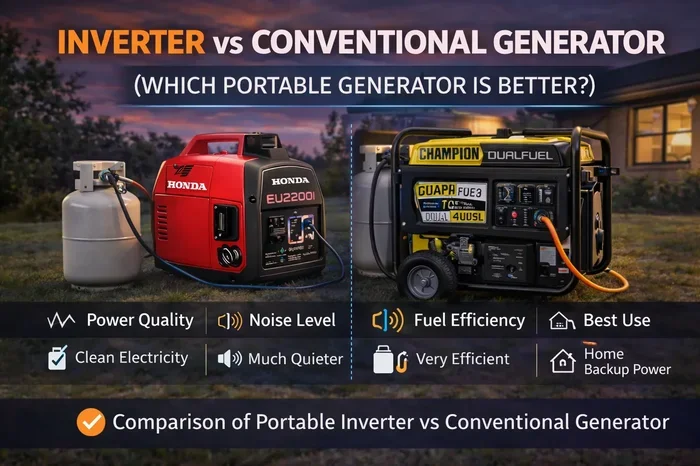
Inverter Generator vs Generator Which Is the Better Choice
An inverter generator delivers clean, stable power with less fuel and noise, while a conventional generator offers higher wattage at a lower price. Choosing between them depends on your power needs, budget, and whether you run sensitive electronics. This guide breaks down every key difference so you can decide with confidence.
When you need backup power or a reliable source of electricity on the go, the debate between an inverter generator vs generator comes up fast. Both types get the job done, but they do it in very different ways. One focuses on clean, efficient power. The other focuses on raw output and affordability.
So which one should you buy? The answer depends on what you plan to power, where you will use it, and how much you are willing to spend. In this guide, we walk through every major difference in plain language. By the end, you will know exactly which type fits your situation best.
Whether you are camping in the woods, powering tools at a job site, or keeping your home running during an outage, this comparison covers it all. Let us dive in and break it down.
Key Takeaways
- Inverter generators produce cleaner power: They convert AC to DC and back, reducing total harmonic distortion for safe use with laptops and phones.
- Conventional generators deliver more raw wattage: They are better suited for heavy-duty tools and large appliances that need high starting watts.
- Fuel efficiency differs greatly: Inverter models adjust engine speed based on load, saving fuel during light use.
- Noise levels favor inverter generators: They run significantly quieter, making them ideal for camping and residential areas.
- Price is a major factor: Conventional generators cost less upfront but may use more fuel over time.
- Portability matters: Inverter generators are typically lighter and more compact for easy transport.
- Match the generator to your needs: Consider what you will power, where you will use it, and how long you need it to run.
📑 Table of Contents
How Inverter Generators Work
An inverter generator uses a three-step process to produce electricity. First, the engine spins an alternator to create high-frequency AC power. Then, a rectifier converts that AC power into DC power. Finally, an inverter converts the DC back into clean AC power.
This process might sound complicated, but it has a big benefit. The result is a very stable electrical current with low total harmonic distortion (THD). THD measures how “clean” the power is. Lower numbers mean safer power for your devices.
Why Clean Power Matters
Sensitive electronics like laptops, smartphones, and TVs need clean power. A dirty power supply with high THD can damage them over time. Inverter generators typically keep THD under 3%, which is safe for almost all household electronics.
Conventional generators often produce THD levels above 20%. That is fine for tools and motors, but it can be risky for delicate devices. If you plan to charge your phone or run a laptop, clean power is a must.
Fuel Efficiency and Engine Speed
One of the biggest advantages of an inverter generator is fuel efficiency. Here is why. The engine adjusts its speed based on the electrical load. If you are running a small device, the engine slows down. If the load increases, the engine speeds up.
Conventional generators run at a constant 3,600 RPM no matter what. This means they burn fuel even when you are not using full power. Over time, the fuel savings from an inverter model can really add up.
How Conventional Generators Work
A conventional generator (also called a standard or open-frame generator) produces AC power directly from the engine and alternator. There is no conversion process. The engine runs at a fixed speed, usually 3,600 RPM, to produce 60 Hz electricity.
This simple design has been around for decades. It is reliable, well-understood, and easy to repair. Many people trust conventional generators for heavy-duty applications.
Higher Power Output
One area where conventional generators shine is raw power output. They are available in much larger sizes than inverter generators. You can easily find conventional models that deliver 5,000, 7,500, or even 10,000+ watts.
This makes them great for running multiple tools at a construction site or powering an entire home during an outage. If you need serious wattage, a conventional generator is hard to beat.
Lower Upfront Cost
Because conventional generators use a simpler design, they cost less to manufacture. You can get a solid conventional portable generator for a fraction of what an inverter model costs.
If you are on a tight budget and need a lot of power, a conventional generator makes sense. Just keep in mind that you may spend more on fuel over the long run.
Inverter Generator vs Generator: Key Differences
Now let us compare the two side by side. This table breaks down the most important factors you should consider.
| Feature | Inverter Generator | Conventional Generator |
|---|---|---|
| Power Quality | Clean, low THD (under 3%) | Higher THD (15-25%) |
| Fuel Efficiency | High (adjustable engine speed) | Lower (constant engine speed) |
| Noise Level | Quiet (45-65 dB) | Louder (65-85 dB) |
| Power Output | Typically 1,000-4,000 watts | Up to 10,000+ watts |
| Weight | Light and portable | Heavier and bulkier |
| Price | Higher upfront cost | Lower upfront cost |
| Parallel Capability | Often supported | Sometimes supported |
| Best For | Electronics, camping, RV trips | Tools, job sites, whole-home backup |
Noise Level Comparison
Nobody wants a generator that sounds like a jet engine. Inverter generators are much quieter than conventional models. Many inverter units run at 50-60 decibels, which is about as loud as a normal conversation.
Conventional generators often run at 70 decibels or higher. That is the equivalent of a vacuum cleaner. If you are using a generator near your home, at a campsite, or in a neighborhood, noise can be a real concern.
Portability and Weight
Inverter generators are designed to be lightweight. Most models weigh between 40 and 80 pounds. Many come with handles and wheels for easy transport.
Conventional generators are heavier. A 7,500-watt unit can easily weigh over 200 pounds. If you need to move your generator often, the lighter inverter option is a clear winner.
Which One Should You Choose?
Choosing between an inverter generator vs generator comes down to your specific needs. Let us look at common scenarios to help you decide.
Choose an Inverter Generator If…
- You need clean power for electronics like laptops, phones, and TVs.
- You want a quiet unit for camping, tailgating, or RV trips.
- Fuel efficiency matters to you, especially for long trips.
- You need a lightweight, portable option you can carry easily.
- You want to run sensitive medical equipment safely.
Choose a Conventional Generator If…
- You need high wattage for power tools or heavy appliances.
- You want the lowest upfront cost possible.
- You are running a job site where noise is less of a concern.
- You need to power multiple high-draw devices at once.
- You plan to use the generator as a backup for your whole house.
Can You Use Both Together?
Some people use both types for different purposes. They keep a small inverter generator for camping and electronics, and a larger conventional generator for home backup. This is a smart approach if your needs vary widely.
If you are considering using a generator to power your home, check out our guide on how to run a generator to your house for important safety tips. Also, if you are curious about fuel costs, our article on how much propane a 20kw generator uses per hour gives great insight into fuel consumption.
Pros and Cons of Each Type
Inverter Generator Pros
- Clean power output safe for all electronics.
- Excellent fuel efficiency saves money over time.
- Quiet operation ideal for residential areas.
- Lightweight and portable easy to transport.
- Parallel capability lets you connect two units for more power.
Inverter Generator Cons
- Higher price tag compared to conventional models of similar wattage.
- Lower maximum output not ideal for very heavy loads.
- Smaller fuel tank may require more frequent refueling on high settings.
Conventional Generator Pros
- Lower purchase price saves money upfront.
- High power output handles heavy loads with ease.
- Simple design easy to maintain and repair.
- Widely available many brands and models to choose from.
Conventional Generator Cons
- Noisy operation can disturb neighbors and wildlife.
- Dirty power risky for sensitive electronics.
- Poor fuel efficiency burns more fuel at all loads.
- Heavy and bulky harder to transport.
Expert Tips for Choosing the Right Generator
Here are some practical tips to help you make the best decision.
Calculate Your Power Needs First
Before buying any generator, list every device you plan to run. Check the running watts and starting watts on each label. Add them up to find the total wattage you need. Always choose a generator with at least 20% more capacity than your total.
Think About Where You Will Use It
Will you use the generator at a campsite? At a job site? At home during a blackout? The location affects which type makes the most sense. For quiet outdoor settings, go with an inverter model. For heavy-duty industrial use, a conventional unit is better.
Consider Long-Term Costs
A cheaper generator may cost more over time due to higher fuel consumption. Factor in fuel costs, maintenance, and expected lifespan when comparing prices. An inverter generator often pays for itself through fuel savings.
Check for Parallel Capability
Many inverter generators allow you to connect two units together for double the power. This is a great feature if you sometimes need more wattage but want the portability and quiet operation of an inverter model.
For more information on generator sizing, you might find our article on what size generator to run furnace and refrigerator very helpful. It covers the specific wattage needs of common household appliances.
Final Verdict
The inverter generator vs generator debate does not have a single winner. It depends entirely on what you need. If you value clean power, fuel efficiency, and quiet operation, an inverter generator is the better choice. If you need raw power, low upfront cost, and heavy-duty capability, a conventional generator wins.
For most homeowners who want to keep their electronics safe and their fuel costs low, an inverter generator is the smarter pick. For contractors and those who need maximum output on a budget, a conventional generator still holds strong.
Take your time, compare models, and choose the generator that fits your lifestyle. The right choice will keep you powered up no matter what comes your way.
Frequently Asked Questions
Is an inverter generator better than a regular generator?
It depends on your needs. An inverter generator is better for clean power, fuel efficiency, and quiet operation. A regular generator is better for high-wattage applications and tight budgets. Choose based on what you plan to power.
Can I run a TV and laptop on a conventional generator?
You can, but there is a risk. Conventional generators produce higher total harmonic distortion, which can damage sensitive electronics over time. An inverter generator is safer for devices like TVs and laptops.
How much quieter is an inverter generator?
Inverter generators are typically 10 to 20 decibels quieter than conventional models. This makes them much more pleasant to use in residential areas, campsites, and RV parks.
Are inverter generators worth the extra cost?
For most people, yes. The fuel savings alone can offset the higher upfront cost over a few years. Plus, you get cleaner power and quieter operation, which adds real value.
What size inverter generator do I need for a house?
Most homes need at least 5,000 to 7,500 watts for essential circuits. However, inverter generators typically max out around 4,000 watts. For whole-house backup, a conventional generator or a larger parallel setup may be needed.
How long do generators last on average?
A well-maintained generator can last 10,000 to 30,000 hours. Inverter generators often last longer because the engine runs at lower speeds during light loads, reducing wear and tear over time.