What Tools Do Chemists Use in Their Everyday Lab Work
Chemists rely on a wide range of essential lab tools every day to conduct experiments, analyze samples, and ensure accurate results. From basic glassware like beakers and Erlenmeyer flasks to advanced instruments such as spectrophotometers and chromatography systems, the right equipment makes all the difference in what tools do chemists use to get reliable data. Safety gear like goggles, gloves, and fume hoods also play a critical role in protecting researchers while they work with hazardous chemicals and volatile substances.
Walking into a chemistry lab for the first time can feel overwhelming. Shelves line the walls with bottles, and counters hold all sorts of chemistry lab equipment that might look like something from a science fiction movie. But every single item has a purpose. In this guide, we will walk you through what tools do chemists use on a daily basis. You will learn about glassware, safety gear, measuring devices, and much more. By the end, you will have a clear picture of how a real lab operates and why each tool matters.
Chemistry is a hands-on science. You cannot just read about reactions and expect to understand them. You need to see, touch, and measure things yourself. That is why laboratory instruments are so important. They let chemists explore the building blocks of matter every single day.
Whether you are a student just starting out or a seasoned researcher, knowing your tools matters. The right chemistry lab equipment can make your work safer, faster, and more accurate. Think of it like a chef knowing their kitchen tools. You would not bake a cake without measuring cups and mixing bowls. In the same way, chemists depend on specific devices to get reliable results.
Key Takeaways
- Glassware is essential: Beakers, flasks, and test tubes handle mixing, heating, and storing chemicals daily.
- Precision matters: Pipettes and burettes ensure accurate liquid measurements for reliable experiments.
- Safety comes first: Fume hoods and PPE protect chemists from toxic fumes and hazards.
- Analysis tools are critical: Spectrometers and chromatographs identify compound structures and compositions precisely.
- Balances enable accuracy: Digital scales measure reagents to exact weights for consistent results.
- Centrifuges speed separation: They quickly separate mixtures by density in lab processes.
- Microscopes reveal detail: They help chemists examine molecular structures and microscopic samples closely.
📑 Table of Contents
- Essential Glassware Every Chemist Reaches For
- What Tools Do Chemists Use for Measuring and Analyzing
- Safety Equipment That Protects Lab Workers
- Heating and Mixing Tools for Chemical Reactions
- Advanced Analytical Equipment in Modern Labs
- Digital Tools and Technology Transforming Chemistry
- Key Takeaways
Essential Glassware Every Chemist Reaches For
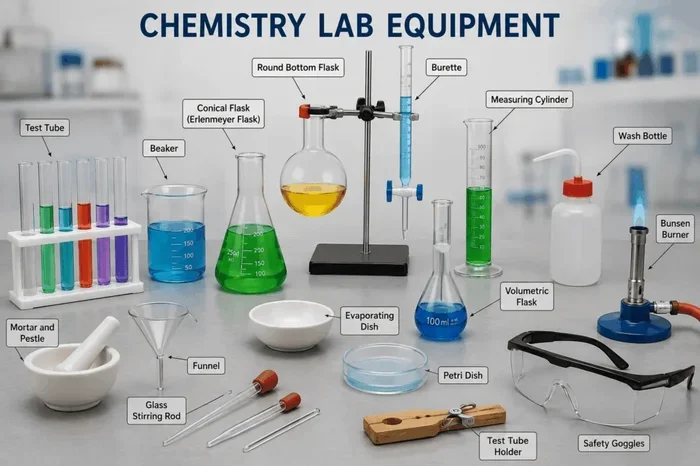
Glassware forms the backbone of any chemistry lab. You will find it on every lab bench, from beginner classrooms to advanced research facilities. Each piece serves a specific role in mixing, heating, or storing chemical substances.
Beakers and Flasks – The Workhorses of the Lab
Beakers are probably the most recognizable pieces of glassware in any lab. They come in many sizes, from small 50 mL beakers to large 2000 mL ones. Chemists use them to mix solutions, heat liquids, and hold chemical reagents during experiments.
Flasks serve a different purpose. Erlenmeyer flasks have a narrow neck and wide base, which helps prevent spills when swirling liquids. Round-bottom flasks, on the other hand, are perfect for heating and distillation. They distribute heat evenly, which is crucial for many chemical reactions.
- Beakers – for mixing and holding liquids
- Erlenmeyer flasks – for swirling and conducting reactions
- Round-bottom flasks – for distillation and even heating
- Volumetric flasks – for preparing precise solutions
Pipettes and Droppers for Precise Measurements
When you need to move tiny amounts of liquid, pipettes and droppers are your best friends. A pipette can measure and transfer as little as 1 mL of liquid with great accuracy. This precision matters a lot in chemistry, where even small errors can change results entirely.
There are different types of pipettes. Graduated pipettes let you measure various volumes. Volumetric pipettes deliver one exact volume. And micropipettes handle very small amounts, often in the microliter range. Every chemist learns to use these tools early in their training because they are essential for analytical chemistry tools work.
Test Tubes and Graduated Cylinders
Test tubes are small, thin glass tubes open at one end. Chemists use them for holding small reactions, heating small amounts of substances, and mixing reagents. They are cheap, disposable, and incredibly useful for quick tests.
Graduated cylinders are taller and narrower than beakers. They are designed specifically for measuring liquid volumes. While they are not as precise as volumetric flasks, they offer a good balance of accuracy and convenience for everyday tasks.
Comparing Common Lab Glassware
Below is a quick comparison of the most common glassware pieces you will find in a chemistry lab. This table helps you understand what each tool does and when to reach for it.
| Glassware Type | Primary Use | Material | Typical Size Range |
|---|---|---|---|
| Beaker | Mixing and holding liquids | Borosilicate glass | 50 mL – 2000 mL |
| Erlenmeyer Flask | Swirling and reactions | Borosilicate glass | 125 mL – 2000 mL |
| Volumetric Flask | Precise solution preparation | Borosilicate glass | 10 mL – 1000 mL |
| Graduated Cylinder | Measuring liquid volumes | Borosilicate glass | 10 mL – 1000 mL |
| Test Tube | Small-scale reactions | Borosilicate glass | 10 mL – 20 mL |
| Pipette | Transferring precise volumes | Glass or plastic | 1 mL – 100 mL |
What Tools Do Chemists Use for Measuring and Analyzing
Accurate measurement is the heart of chemistry. Without the right measuring instruments, even the best experiments will give unreliable results. Chemists rely on a range of devices to quantify their work with precision.
Digital Scales for Accurate Weighing
Every chemistry lab needs a good digital scale. These measuring instruments let chemists weigh chemical reagents down to fractions of a gram. Analytical balances go even further, measuring as precisely as 0.0001 grams.
Why does this matter? Because chemical reactions depend on exact ratios. Too much or too little of a substance can change the entire outcome of an experiment. Digital scales remove the guesswork and give chemists confidence in their measurements.
pH Meters and Their Role
A pH meter measures how acidic or basic a solution is. This is one of the most common measurements in any lab. Whether you are testing water quality or monitoring a reaction, knowing the pH is essential.
Modern pH meters are digital and very accurate. They use a probe dipped into the solution to give an instant reading. Chemists calibrate them regularly with buffer solutions to keep measurements trustworthy.
Microscopes for Viewing the Small
Some chemistry work involves things you cannot see with the naked eye. That is where microscopes come in. They let chemists observe crystals, tiny organisms, and material structures at a microscopic level.
Compound microscopes are the most common type in chemistry labs. They use multiple lenses to magnify samples up to 1000 times. Stereo microscopes offer lower magnification but better depth perception, which is useful for handling small objects.
Safety Equipment That Protects Lab Workers
Safety comes first in every chemistry lab. Working with chemical reagents and unknown substances can be dangerous. That is why lab safety gear is not optional. It is a must-have for every chemist.
Protective Eyewear and Lab Coats
Safety goggles protect your eyes from splashes, fumes, and flying debris. They are one of the most important pieces of lab safety gear you can wear. Every chemist should put them on before starting any experiment.
Lab coats provide an extra layer of protection. They shield your skin and clothing from spills and splashes. Most lab coats are made from flame-resistant materials, which adds another layer of safety when working with heat or reactive substances.
Fume Hoods and Lab Ventilation
A fume hood is a ventilated enclosure that pulls dangerous fumes away from the chemist. It is one of the most important pieces of lab ventilation equipment. When working with volatile or toxic chemicals, a fume hood keeps you safe.
The hood draws air away from your workspace and filters it before releasing it outside. This prevents harmful vapors from building up in the lab. Every chemistry lab should have several fume hoods available for use.
Gloves and Emergency Equipment
Gloves are the last line of defense for your hands. Different experiments require different types of gloves. Nitrile gloves are the most common because they resist many chemicals. But some experiments need thicker gloves or ones made from other materials.
Beyond personal gear, every lab should have emergency equipment on hand. This includes fire extinguishers, eyewash stations, and first aid kits. Knowing where these are and how to use them is just as important as wearing the right gear.
Heating and Mixing Tools for Chemical Reactions
Many chemical reactions need heat or constant mixing to proceed. Chemists use a variety of tools to provide both. These tools control temperature and agitation with precision.
Bunsen Burners and Hot Plates
The Bunsen burner is a classic lab tool. It produces a single open gas flame that can reach very high temperatures. Chemists use it to heat substances in beakers, test tubes, and flasks.
Hot plates offer a safer alternative. They heat containers from below without an open flame. This is especially useful when working with flammable liquids. Many modern hot plates also include magnetic stirring features.
Stirrers and Shakers
Mixing solutions evenly is crucial for consistent results. Magnetic stirrers use a spinning magnet to stir liquids in a container. They provide smooth, continuous mixing without any manual effort.
Orbital shakers move containers in a circular motion. They are great for growing cultures or mixing larger volumes of liquid. Both tools save time and improve the quality of your experiments.
Steam Generators in the Lab
Another common lab device is the steam generator, which chemists use for sterilization and heating applications. Steam generators produce controlled steam that can sterilize equipment or provide gentle heat for certain reactions. They are especially useful in labs that need to maintain sterile conditions for sensitive experiments.
Steam generators are also helpful for distillation processes. They provide a steady source of heat without the risks associated with open flames. This makes them a safer choice for many everyday lab tasks.
Advanced Analytical Equipment in Modern Labs
Modern chemistry labs go far beyond basic glassware. Advanced analytical chemistry tools allow chemists to study substances at the molecular level. These instruments provide detailed data that drives research and discovery.
Chromatography Tools for Separation
Chromatography is a technique used to separate mixtures into their individual components. There are several types, including gas chromatography and liquid chromatography. Each one works by passing a mixture through a medium that separates the parts based on their properties.
Chemists use chromatography to identify unknown substances, check purity levels, and analyze complex samples. It is one of the most widely used separation techniques in both research and industry labs.
Spectroscopy Equipment for Detailed Analysis
Spectroscopy equipment helps chemists understand what a substance is made of. Different types of spectroscopy use light, infrared waves, or nuclear magnetic resonance to analyze samples at the molecular level.
If you want to learn more about how signal generators work in lab settings, it is worth noting that they play a role in some spectroscopy instruments. Signal generators produce precise electrical signals that help calibrate and operate analytical devices like NMR spectrometers and mass spectrometers.
Centrifuges for Separation and Purification
A centrifuge spins samples at very high speeds. This force separates substances based on their density. Chemists use centrifuges to separate liquids from solids, isolate DNA, and purify samples.
There are many types of centrifuges. Benchtop models are common in teaching labs. Ultracentrifuges can reach speeds over 100,000 RPM and are used in advanced research. Every chemist should know how to operate one safely.
Digital Tools and Technology Transforming Chemistry
Technology has changed the way chemists work. Digital tools make experiments faster, more accurate, and easier to document. Modern labs rely on software and electronic devices to stay organized and efficient.
Computers and Data Software
Computers are now central to chemistry work. Chemists use software to analyze data, model reactions, and track experiments. Digital tools reduce human error and make it easier to share results with colleagues around the world.
Data management software also helps labs stay organized. Researchers can store results, track samples, and generate reports all in one place. This saves time and keeps information secure.
Tone Generators for Calibration
For calibrating sensitive instruments, a tone generator can be very useful in certain lab settings. Tone generators produce precise audio frequencies that help verify the accuracy of electronic measuring devices. While not every lab needs one, they are a valuable tool for quality control and instrument maintenance.
Process Workflow Tools for Lab Organization
Organizing your lab work efficiently is easier with process workflow tools. These digital systems help chemists track实验步骤, manage schedules, and ensure that every procedure follows the correct protocol. Good workflow management reduces errors and keeps the lab running smoothly.
Many labs now use digital platforms that connect equipment, data, and team members. This integration makes it easier to collaborate and share findings. As technology continues to advance, these tools will become even more essential in everyday lab work.
Key Takeaways
What tools do chemists use in their everyday lab work? The answer spans a wide range of equipment. From basic glassware like beakers and pipettes to advanced instruments like spectrometers and centrifuges, each tool plays a vital role.
Safety gear protects chemists from harm. Measuring instruments ensure accuracy. Heating tools drive reactions forward. And digital technology makes the whole process faster and more efficient. Together, these tools create the foundation of modern chemistry.
If you are new to the lab, start by getting comfortable with the basics. Learn how to use each piece of chemistry lab equipment properly. Ask experienced chemists for guidance. Over time, you will build the confidence and skill to handle even the most advanced laboratory instruments.
The world of chemistry is vast and exciting. The right tools open doors to discovery, innovation, and real-world problem solving. So the next time you walk into a lab, take a moment to appreciate all the equipment around you. Each piece is there for a reason, and together they make scientific progress possible.
Frequently Asked Questions
What tools do chemists use in their everyday lab work?
Chemists rely on a core set of tools including beakers, flasks, pipettes, Bunsen burners, and graduated cylinders for handling and measuring liquids. They also use analytical instruments like spectrophotometers and balances to get precise measurements. These essential tools form the foundation of virtually every chemistry experiment performed in labs worldwide.
What safety equipment is essential for a chemistry lab?
Every chemist’s workspace needs safety goggles, lab coats, and chemical-resistant gloves as a basic protective setup. Fume hoods are also critical because they pull harmful vapors away from the researcher during experiments. Having fire extinguishers and eyewash stations nearby adds an extra layer of protection in case of accidents.
Do chemists use digital tools and software in modern labs?
Yes, modern chemists frequently use software for data analysis, molecular modeling, and lab inventory management. Programs like ChemDraw help them sketch chemical structures, while lab information management systems keep experiments organized. These digital tools save time and reduce human error in complex research workflows.
What measuring tools do chemists need for precise experiments?
Precision is everything in chemistry, so chemists depend on analytical balances, volumetric flasks, and pipettes to measure ingredients accurately. Thermometers and pH meters also help them monitor reaction conditions closely. Even small measurement errors can throw off an entire experiment, which is why these tools matter so much.
What heating and cooling tools are commonly found in chemistry labs?
Bunsen burners, hot plates, and heating mantles are standard tools chemists use to apply heat to reactions or substances. On the cooling side, ice baths and condensers help control temperature during distillation and other processes. Having both heating and cooling options gives chemists full control over their experimental conditions.
How do chemists choose the right glassware for their experiments?
The choice of glassware depends on the specific task, whether it is mixing, heating, measuring, or storing chemicals. Beakers work well for general mixing, while Erlenmeyer flasks are better for titrations and reactions that produce gas. Chemists select each piece based on the volume needed, the type of reaction, and the level of precision required.