What Is One of the Tools Associated with Design Thinking
Design thinking is a powerful approach to problem-solving, and knowing what is one of the tools associated with design thinking can unlock new levels of creativity. From empathy mapping to prototyping, these tools help teams understand users, challenge assumptions, and build better solutions faster.
Key Takeaways
- Empathy maps are one of the most foundational tools associated with design thinking, helping teams understand user emotions and needs.
- Prototyping allows teams to test ideas quickly and affordably before committing to a final product.
- Journey mapping visualizes the user experience from start to finish, revealing pain points and opportunities.
- Brainstorming and mind mapping encourage free-flowing ideation and break down mental blocks.
- Rapid experimentation is at the heart of design thinking, reducing risk through early testing.
- Collaboration across disciplines makes design thinking tools more effective and produces richer solutions.
📑 Table of Contents
- What Is One of the Tools Associated with Design Thinking?
- Understanding Design Thinking and Its Core Tools
- Empathy Mapping: The Foundation of User-Centered Design
- Prototyping: Turning Ideas into Tangible Tests
- Journey Mapping: Visualizing the Full User Experience
- Brainstorming and Mind Mapping: Unlocking Creative Ideation
- The “Five Whys” and Root Cause Analysis Tools
- Choosing the Right Tool for Your Challenge
- Conclusion
What Is One of the Tools Associated with Design Thinking?
When people ask about what is one of the tools associated with design thinking, they are usually looking for a practical method they can use right away. Design thinking is not just a buzzword. It is a human-centered framework for solving problems creatively. At its core, it relies on a set of powerful tools that help teams understand users, challenge old assumptions, and build solutions that truly work. One of the most widely recognized tools is the empathy map, but the full toolkit goes far beyond that. In this article, we will break down the key tools, explain how they work, and show you how to use them effectively.
Whether you are a product manager, a teacher, or someone who just wants to think more creatively, these tools give you a clear path forward. They turn vague ideas into actionable plans. Let us dive in and explore what makes design thinking so effective and which tools you should reach for first.
Understanding Design Thinking and Its Core Tools
What Exactly Is Design Thinking?
Design thinking is a problem-solving approach that puts people first. It was popularized by Stanford’s d.school and has since spread across industries worldwide. The process typically follows five stages: empathize, define, ideate, prototype, and test. Each stage calls on specific tools to move the work forward. These stages are not always linear. Teams often loop back and revisit earlier steps as new insights emerge.
The beauty of design thinking lies in its flexibility. You do not need a big budget or a formal team to start. You just need curiosity and a willingness to listen. The tools associated with design thinking make that curiosity structured and productive. They help you move from guessing to knowing, from assumptions to evidence.
Why Tools Matter in the Design Thinking Process
Tools give shape to abstract thinking. Without them, design thinking can feel like just another brainstorming session. The right tools force you to slow down, look deeper, and challenge your own biases. They also create a shared language for teams. When everyone uses the same visual templates and frameworks, communication improves dramatically.
Some teams jump straight to solutions. That is a common mistake. The tools associated with design thinking exist to prevent that rush. They ensure you spend enough time understanding the real problem before you start building anything. That alone saves enormous amounts of time and money in the long run.
Empathy Mapping: The Foundation of User-Centered Design
What Is an Empathy Map?
If you want to know what is one of the tools associated with design thinking, the empathy map is the classic answer. An empathy map is a visual tool that helps teams capture what users think, feel, say, and do. It is usually drawn as a square divided into four quadrants. Each quadrant represents a different dimension of the user experience.
The four sections are: Say, Think, Feel, and Do. The “Say” section captures direct quotes from users. The “Think” section records internal thoughts, even if the user never says them out loud. The “Feel” section addresses emotions and emotional states. The “Do” section lists observable actions and behaviors.
How to Build an Empathy Map in Five Steps
- Step 1: Choose a specific user persona. Focus on one person or one user group at a time.
- Step 2: Gather data through interviews, surveys, or observation. Real input is critical here.
- Step 3: Set up the empathy map template on a whiteboard or large sheet of paper.
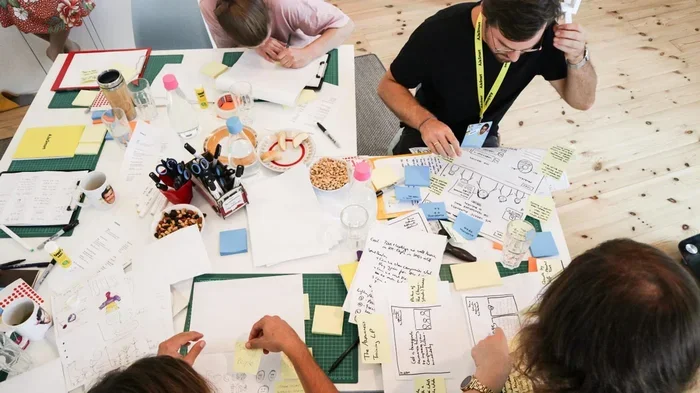
- Step 4: Fill in each quadrant with sticky notes. Encourage team members to contribute independently before discussing.
- Step 5: Cluster similar notes and look for patterns. These patterns reveal deep insights about user motivations.
Real-World Example of Empathy Mapping
Imagine a team designing a new mobile banking app. They interview elderly users who find current apps confusing. The empathy map reveals that users “think” they are too old to learn new technology, even though they “say” they want to try. They “feel” anxious about making mistakes. Their “do” involves calling a family member for help. This insight completely shifts the design approach. The team now knows they need to build confidence, not just features.
This is why empathy mapping remains one of the most powerful tools associated with design thinking. It surfaces hidden truths that surveys alone cannot capture.
Prototyping: Turning Ideas into Tangible Tests
The Role of Prototyping in Design Thinking
Once you understand your users through empathy mapping and related tools, the next logical step is to build a prototype. Prototyping is a hands-on tool that lets teams create rough, early versions of a product or solution. The goal is not perfection. The goal is learning. A prototype can be anything from a paper sketch to a clickable digital mockup to a simple physical model.
Rapid prototyping is a core principle here. Teams build fast, fail fast, and learn fast. This iterative cycle reduces risk. It also makes it easier to spot problems before investing heavily in development. Prototyping directly supports the “test” phase of design thinking, where real users interact with the idea and provide honest feedback.
Types of Prototypes You Can Use
- Paper prototypes: Simple hand-drawn screens. Great for early-stage UI concepts and quick user testing.
- Digital wireframes: Low-fidelity layouts made in tools like Figma or Balsamiq. Good for mapping user flows.
- Physical models: 3D-printed or handmade objects. Perfect for product design and spatial thinking.
- Role-play prototypes: Simulating a service experience with people acting out roles. Useful for healthcare, hospitality, and retail.
- Video prototypes: Short screen recordings that simulate how a digital product would work. Ideal when engineering resources are limited.
Tips for Effective Prototyping
Keep your prototype ugly. The moment it looks polished, people hesitate to criticize it honestly. Set a strict time limit. A two-hour deadline forces focus and prevents over-engineering. Always test with real users, not just colleagues. Colleagues tend to be polite. Real users tell you the truth. These simple habits make prototyping one of the most valuable tools associated with design thinking.
Journey Mapping: Visualizing the Full User Experience
What Is a Journey Map?
A journey map is a visual storytelling tool that tracks a user’s experience over time. While an empathy map focuses on a single moment or mindset, a journey map takes a broader view. It walks through every stage a user goes through, from first awareness to ongoing use and beyond. It highlights touchpoints, emotions, pain points, and moments of delight.
Journey mapping is especially useful for services and experiences that involve multiple steps. Think about booking a hotel, enrolling in a university, or visiting a doctor. These experiences have complex paths, and a journey map helps teams see the full picture at once.
Key Components of a Journey Map
- Persona: The specific user whose journey you are mapping. This keeps the map focused and realistic.
- Stages: Major phases of the experience, such as awareness, consideration, purchase, and support.
- Touchpoints: Where the user interacts with your product, service, or brand, such as a website, call center, or in-store visit.
- Emotions: How the user feels at each stage. This is where empathy work pays off.
- Pain points: Specific frustrations or barriers the user encounters.
- Opportunities: Areas where you can improve the experience or create a competitive advantage.
Why Journey Maps Transform Team Collaboration
Journey maps create a shared mental model. When a marketing specialist, a developer, and a customer service manager all look at the same journey map, they finally understand each other’s perspectives. Silos break down. Teams start working toward the same user goals instead of departmental goals. This collaborative clarity is a huge reason why journey mapping is considered one of the essential tools associated with design thinking.
Brainstorming and Mind Mapping: Unlocking Creative Ideation
How Brainstorming Supports Design Thinking
Once you have mapped the user and defined the problem, it is time to generate solutions. Brainstorming is the classic idea-generation tool, but design thinking teams use it differently than most. They follow a few key rules. First, defer judgment. No idea is too silly or too impossible during the brainstorming phase. Second, aim for quantity. More ideas mean better odds of finding a breakthrough one. Third, build on each other’s ideas. Collaboration during brainstorming often leads to ideas that no single person would have reached alone.
Structured brainstorming sessions typically last between 20 and 45 minutes. Short sessions keep energy high and prevent fatigue. Teams that brainstorm regularly develop a creative culture that extends well beyond formal design thinking projects.
Mind Mapping as a Visual Brainstorming Tool
Mind mapping takes brainstorming a step further by organizing ideas visually. You start with a central concept in the middle of a page. Then you branch out into related themes, subtopics, and specific ideas. The branching structure mirrors how the brain actually associates concepts. This makes mind mapping an incredibly natural tool for creative problem-solving.
Teams often use mind maps during the “ideate” phase of design thinking. They help you see connections that linear lists hide. For example, a mind map about “improving customer support” might branch into “faster response times,” “self-service options,” and “empathetic communication.” Under each branch, specific ideas emerge. This visual layout makes it easy to spot gaps, duplicates, and high-potential concepts.
Quick Tips for Better Brainstorming and Mind Mapping
- Use a timer to keep sessions focused and energetic.
- Assign a “note-taker” to capture every idea visually.
- Rotate facilitators so different voices guide the conversation.
- Display mind maps prominently so teams can revisit them later.
- Combine mind mapping with voting sessions to prioritize the strongest ideas.
The “Five Whys” and Root Cause Analysis Tools
Asking “Why” Five Times
Another critical tool associated with design thinking is the Five Whys method. This simple technique was developed by Sakichi Toyoda, the founder of Toyota Industries. The idea is straightforward: when you encounter a problem, ask “why” five times in a row. Each answer becomes the basis for the next question. This process peels away surface-level symptoms and reveals the true root cause.
For example, a team notices that a product ships late. They ask why. Answer: “The warehouse missed the packing deadline.” Why? “The packing team did not receive the order details on time.” Why? “The system notification failed to trigger.” Why? “The integration between the sales and warehouse platforms was not configured correctly.” Why? “There was no owner assigned to maintain that integration.” Now the team has a root cause they can actually fix, instead of just telling the packing team to hurry up.
Why Root Cause Analysis Fits Design Thinking Perfectly
Design thinking emphasizes deep understanding before action. The Five Whys aligns perfectly with that philosophy. It prevents teams from jumping to solutions that only address symptoms. Combined with empathy maps and journey maps, the Five Whys ensures that the problem definition phase is rigorous and thorough. This is what separates design thinking from ordinary brainstorming sessions that often miss the mark.
Choosing the Right Tool for Your Challenge
Matching Tools to Problem Types
Not every problem needs every tool. Choosing wisely saves time and produces sharper results. Here is a simple guide to help you match the right tool to your situation.
- User confusion or frustration: Start with an empathy map. It helps you understand emotions and unmet needs.
- Complex multi-step processes: Use a journey map to see the full experience and identify broken touchpoints.
- Lack of ideas or direction: Run a brainstorming session supported by mind mapping to generate and organize concepts.
- Recurring problems or failures: Apply the Five Whys to dig into root causes before proposing fixes.
- Uncertain whether an idea will work: Build a rapid prototype and test it with real users immediately.
Combining Tools for Maximum Impact
The most effective teams do not use tools in isolation. They combine them strategically. A typical project might start with empathy mapping to understand the user, move to journey mapping to visualize the experience, then use brainstorming to generate solutions, and finish with prototyping and testing to validate the best ideas. The Five Whys can be woven in at any point where a problem resurfaces.
This integrated approach is what makes design thinking so powerful. Each tool feeds into the next. The result is a coherent, evidence-based innovation process that consistently outperforms guesswork. Understanding what is one of the tools associated with design thinking is just the starting point. Knowing how to combine them is where the real value emerges.
Common Mistakes When Using Design Thinking Tools
- Skipping the empathy phase and jumping straight to solutions.
- Using tools without gathering real user input first.
- Treating design thinking as a one-time event instead of an ongoing practice.
- Overcomplicating templates and processes, which kills team momentum.
- Ignoring negative feedback during prototype testing sessions.
Avoiding these mistakes will put you ahead of most teams. Design thinking tools work best when you commit to the full process with honesty and openness. Keep your focus on the user, stay curious, and iterate relentlessly.
Conclusion
Design thinking is one of the most effective frameworks for creative problem-solving available today. Tools like empathy mapping, prototyping, journey mapping, brainstorming, mind mapping, and the Five Whys each play a unique role. Together, they help teams understand users deeply, challenge assumptions boldly, and build solutions that truly make a difference. The next time someone asks you what is one of the tools associated with design thinking, you will have a confident, detailed answer. More importantly, you will know how to put these tools into action and drive real innovation.
Frequently Asked Questions
What is one of the tools associated with design thinking?
One of the most recognized tools is the empathy map, which helps teams understand what users think, feel, say, and do. Other key tools include prototyping, journey mapping, brainstorming, mind mapping, and the Five Whys. Each tool serves a specific purpose within the design thinking framework.
Why is empathy mapping important in design thinking?
Empathy mapping is important because it forces teams to look beyond assumptions and surface-level data. It captures the full emotional and behavioral picture of a user. This deeper understanding leads to more human-centered solutions and prevents teams from building things that sound good on paper but fail in real life.
Can prototyping be done without a technical background?
Absolutely. Prototyping does not require coding or engineering skills. Paper sketches, storyboards, and role-play scenarios are all valid forms of prototyping. The goal is to communicate an idea clearly enough to get useful feedback. Low-fidelity prototypes are often better because they encourage honest criticism.
How long does a design thinking project typically take?
A design thinking project can range from a few days to several months depending on the complexity of the problem. Small, focused sprints can produce meaningful results in one to two weeks. Larger organizational challenges may require longer timelines, but even those benefit from short, iterative cycles rather than one extended effort.
Are design thinking tools only for product development?
No. Design thinking tools are used across many fields including education, healthcare, government services, and social impact work. Any domain that involves human users and complex problems can benefit from these methods. Schools use journey maps to improve student experiences. Hospitals use empathy maps to redesign patient care workflows.
How do teams decide which design thinking tool to use first?
Teams typically start with the tool that addresses their biggest current gap. If user understanding is weak, empathy mapping is the natural starting point. If the problem space is unclear, the Five Whys can help. If solutions are scarce, brainstorming and mind mapping come into play. The key is matching the tool to the actual need rather than following a rigid sequence.